





Eye For Film >> Movies >> Where Is Juan Moctezuma? (2025) Film Review



Alaric S Rocha has been a fan of cult Mexploitation director Juan Moctezuma for as long as he can remember. This documentary, which screened as part of Frightfest 2025, is his second on the subject, this time focusing on the man himself more than on his work. Exuberant in its praise, it may be a little unrealistic in its appraisal of the man referred to early on as ‘the Fellini of Mexico’, but there’s no doubting that the species of cinema he excelled at means a great deal to a great many people. Furthermore, this is a fascinating study in the way that creative artists are romanticised – and it is a ripping yarn.
It beings with a funeral – Siegfried’s Funeral, that is, blasting out over the one remaining scene from the lost 1977 film 1,000 Paths Of Death. This, Rocha assures us, would have been Moctezuma’s masterpiece, in part because it had the backing of Roger Corman. Far be it for me to dismiss Corman’s artistry, but for all his ability as a director (he is introduced here, curiously, with reference to She Gods Of Shark Reef, not exactly his most celebrated endeavour) he was, as is later acknowledged, a producer with a reputation for taking on films based on their titles alone. At any rate, the film never had the chance to wow the world, because later that year Moctezuma disappeared, taking it with him.

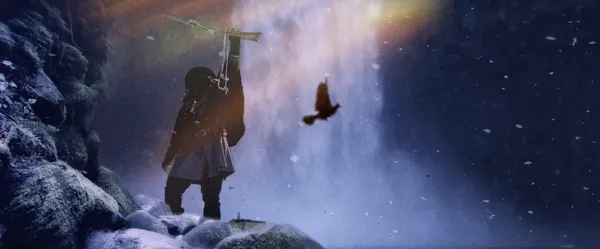
There are clues in that surviving scene. A threatened rape; a heroic rescue; a misogynistic killing, whose victim expresses gratitude for it, and then the hero, handsomely framed beside a waterfall, calling out the name of his lost love as he prepares to resume his eternal search for her. Rocha finds echoes of these things in the director’s own story. As he explores it, however, he finds his own attitude towards it changing, to the point where he’s no longer sure how to feel abut his idol.
Someday, perhaps, somebody will tell the story of Lisa de la Luna. As it is, we know relatively little about her beyond her career details and her relationships with men. She grew up in the same small village as Moctezuma, who set out to seek his fortune in the film business, figuring that if he were successful, and made her into a star, she would love him. Indeed, she may have done so at one time, or she may already have rejected him and not been listened to; but at any rate, she married another man, the famous luchador El Scorpion, and Moctezuma took it badly. One gets the impression that the younger Rocha saw something heroic in this – a man devoting his whole life to a woman and never giving up on her. Women wo have experienced life with such men, however, rarely see their stories in quite such a rosy light.
Interviewing people who knew them, Rocha struggles to pin any blame on El Scorpion, who was by all accounts a man of honour who doted on his wife. His son, also a luchador and, in keeping with that tradition, wearing his mask throughout his interviews, has that untrained celebrity characteristic of sounding like a bad actor when talking about his own life, but his love for his parents comes through clearly. He’s one of several people whom Rocha reaches out to to try to fill in the gaps around Moctezuma’s disappearance, and to explore other events in the director’s life.
Though much of Mocrezuma's behaviour, as described here, is obnoxious to the point where one wonders why anybody associated with him at all, there is more to Moctezuma’s story, and there were times when what he did had a positive effect on the world and those around him. There are little things like his time working as a projectionist at Mexico City’s Cine opera, where he would screen the likes of Devil Girl From Mars; impactful actions like his commemoration of the 1968 Tlatelolco Square massacre in the form of horror film The Beasts, to make it harder to censor and give people a much-needed chance to discuss it; and there are moment of creative cross-pollination, such as his meeting with Alejandro Jodorowsky. We hear about his involvement with the Peter Cushing film Horror Express, and of the effect that his work could have on audiences during his brief period of popularity, when luchadores would fight in the ticket queue. There are enough details here to spawn a lot of conspiracy theories.
Was it because of Lisa that Moctezuma vanished. Was he, as a man who constantly poured money into his films, in debt to the cartels? Was his cocaine habit an issue? Or – stepping a little further over to the wild side – did he make enemies among the still-loyal worshippers of Ancient Aztec gods by messing with their traditions in order to make his horror films more sensational? Here Rocha titillates his audience by revealing that some of those who went looking for the director have also vanished. Of course, this does nothing to deter him.
The final chapters of the documentary flip all this on its head with a series of revelations that make for thrilling viewing but deepen Rocha’s dilemma. Though he has come to see Moctezuma as a mythic figure, he cannot escape his unpleasantly human side. Though he has banked a good deal on tracking him down, to converse with him would likely make the illusion still more difficult to maintain. In order to keep some fragment of his dreams intact, he has to let this aspect of his own obsession go.
Reviewed on: 29 Aug 2025